If you’re wondering whether your car’s paint has lost its luster or you’re starting to notice fine scratches and swirl marks under sunlight, it might be time to consider Premium Paint Correction in Ashburn. Many vehicle owners mistake regular polishing or waxing for paint correction, but they’re not the same. Paint correction is a precise, technical, and transformative process that restores the clarity and depth of your vehicle’s paintwork — bringing it back to a better-than-new condition.
In this comprehensive guide, Grizzly Auto Detailing explains the signs you need paint correction, the detailed process, and how to protect your investment for years to come.
Understanding Paint Correction
Paint correction is the professional process of removing defects from the vehicle’s clear coat, such as scratches, swirl marks, water spots, oxidation, or marring. The goal isn’t to hide these imperfections but to permanently eliminate them through measured polishing and refining techniques.
Unlike a simple polish or wax, paint correction levels out the clear coat — meaning it restores smoothness and optical clarity by gently removing microscopic layers of paint until imperfections are gone. At Grizzly Auto Detailing, our Premium Paint Correction in Ashburn service combines years of expertise, cutting-edge technology, and meticulous attention to detail to achieve flawless results.
Why Paint Correction Matters
Your car’s paint is more than just aesthetic; it’s a protective layer that shields your vehicle from UV rays, dirt, contaminants, and moisture. Over time, daily driving, washing, and exposure to the elements can degrade this protective layer. Paint correction rejuvenates it, restoring gloss and extending the life of your finish.
When performed correctly, it can:
- Revive faded or dull paint.
- Remove light scratches and swirl marks.
- Correct oxidation and water spots.
- Improve the depth and richness of color.
- Prepare your surface for long-term protection like ceramic coating.
But how do you know when it’s time to get this service? Let’s break it down.
Signs You Need Paint Correction
1. Your Paint Looks Dull or Hazy
Even if you wash and wax your car regularly, over time, the paint can lose its mirror-like reflection. This dullness comes from thousands of microscopic scratches and contaminants that scatter light instead of reflecting it uniformly.
At Grizzly Auto Detailing, we see this issue often — particularly on dark-colored vehicles, which show defects more clearly. Our Premium Paint Correction in Ashburn restores that deep, wet-gloss finish by leveling the clear coat and removing years of wear.
2. Swirl Marks Under Direct Sunlight
If you notice circular marks when sunlight or streetlights hit your car, you’re seeing swirl marks — the most common indicator that your paint needs correction.
These are fine scratches caused by improper washing techniques, automatic car washes, or dirty towels. They don’t just dull the appearance — they break up reflections and ruin the finish.
During our paint correction service, we use dual-action polishers, professional-grade pads, and compounds to eliminate swirl marks safely and restore optical clarity.
3. Water Spots That Don’t Wash Off
Water spots can etch into your clear coat when minerals and contaminants dry on the surface. Once embedded, no regular wash or wax can remove them. If your car has persistent circular marks even after washing, that’s a strong sign you need professional correction.
At Grizzly Auto Detailing, we use advanced cutting and refining compounds that safely remove etching and restore a smooth, uniform finish.
4. Surface Feels Rough to the Touch
Run your hand gently across your car’s surface. Does it feel like sandpaper instead of glass? That’s contamination. Industrial fallout, brake dust, and environmental debris bond to your clear coat over time.
Even if your paint looks clean, contamination can create micro-abrasions and prevent wax or sealant from bonding properly. Paint correction, combined with proper decontamination, ensures a silky-smooth, contaminant-free surface.
5. Scratches Visible in Direct Light
Fine scratches — especially on door handles, side mirrors, or hood — are another clear sign. Many of these can be removed through single or multi-stage correction.
Our Premium Paint Correction in Ashburn process removes up to 95% of visible surface defects without compromising the paint thickness.
6. Your Paint Has Oxidation or Fading
If your car looks chalky or faded, oxidation has likely occurred. This happens when the paint’s oils dry out due to UV exposure and environmental contaminants.
Professional paint correction removes this oxidized layer, reviving the color and preparing it for protection like ceramic coatings or high-end waxes.
7. You’re Preparing for a Ceramic Coating or Sale
Paint correction is essential before applying any long-term protection, especially ceramic coating. Applying a coating over uncorrected paint locks in defects permanently.
Likewise, if you’re planning to sell your car, a paint correction dramatically boosts resale value and curb appeal.
What Happens During Paint Correction?
At Grizzly Auto Detailing, we follow a structured, step-by-step process to ensure perfection.
Step 1: Deep Cleaning and Decontamination
We start with a foam pre-wash and two-bucket hand wash using pH-balanced shampoo. Then we perform chemical decontamination (iron remover, tar remover) and clay bar treatment to eliminate embedded contaminants.
Step 2: Paint Inspection and Measurement
We inspect the paint under multiple light sources and measure clear coat thickness using digital gauges. This allows us to determine the safest approach.
Step 3: Test Spot Correction
Before we polish the entire car, we test different pad and compound combinations on a small section to find the most effective, least aggressive method.
Step 4: Compounding (Cutting)
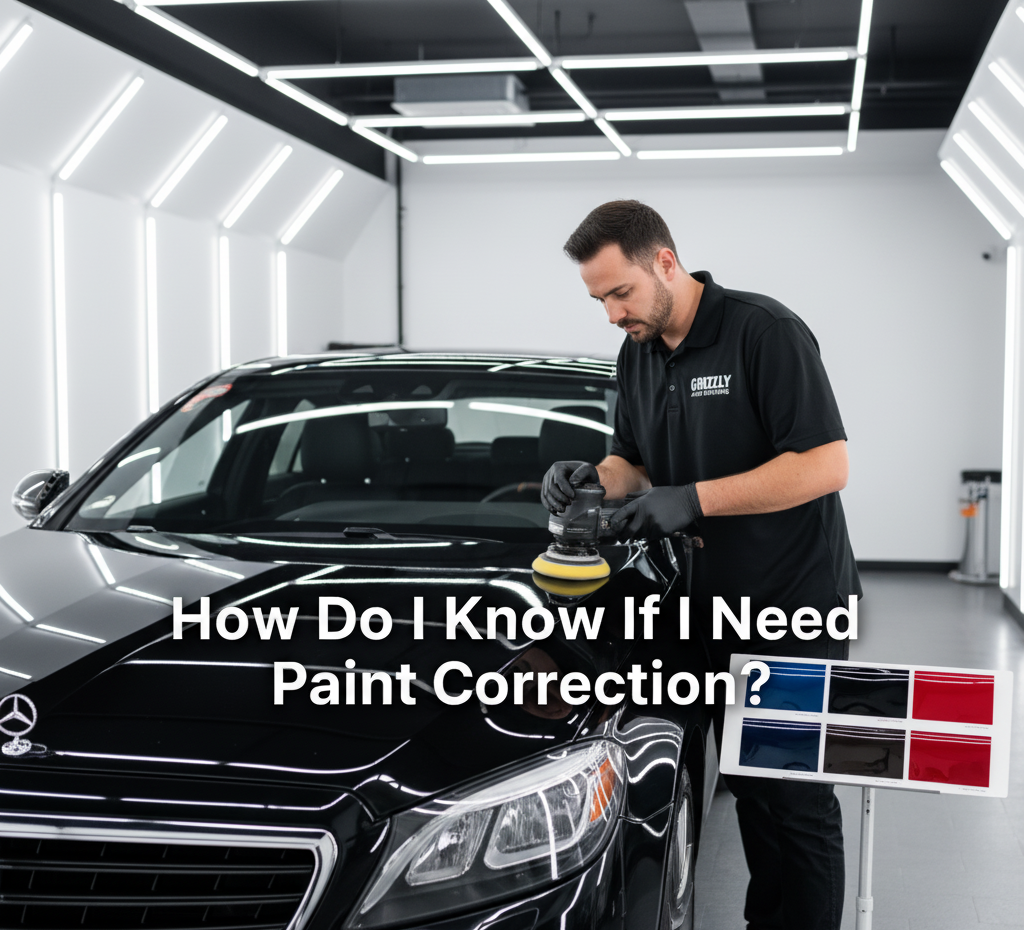
We use a high-quality compound with a microfiber or wool pad to remove deeper scratches, oxidation, and heavy swirl marks. Machines like the Rupes or Flex polishers allow precise correction without overheating the paint.
Step 5: Polishing (Refining)
After compounding, we refine the surface using a fine finishing polish and foam pad to enhance gloss and depth. This step ensures clarity, mirror reflection, and flawless finish.
Step 6: Surface Wipe-Down
We use an isopropyl alcohol (IPA) wipe to remove polishing oils and ensure a residue-free surface, ready for inspection or protection.
Step 7: Paint Protection (Optional but Recommended)
Finally, we apply protection — a premium wax, sealant, or ceramic coating — to maintain the corrected finish for years.
Realistic Expectations
Paint correction doesn’t mean your car will be permanently immune to new scratches or damage. It means we restore the surface to its best possible condition — and with proper care, you can maintain that perfection for years.
For daily drivers, we recommend pairing correction with ceramic coating for long-term durability. For garage-kept vehicles or weekend drivers, a premium wax or sealant may suffice.
Expert Tips to Maintain a Corrected Finish
- Use proper washing techniques: Always use the two-bucket method with grit guards.
- Avoid automatic car washes: They cause new swirl marks.
- Dry with microfiber towels: Prevents scratches and lint.
- Apply ceramic coatings or sealants: Adds UV protection and hydrophobic properties.
- Perform regular maintenance washes: Keeps contaminants from bonding.
- Use quick detailer sprays: Maintain gloss between washes.
By following these practices, you’ll extend the results of your Premium Paint Correction in Ashburn and keep your car looking pristine.
Common Myths About Paint Correction
Myth 1: Waxing is the same as correction.
Wax hides defects temporarily; correction removes them permanently.
Myth 2: Paint correction damages the paint.
When done by professionals using proper tools, it safely removes only microns of clear coat — restoring clarity, not harming it.
Myth 3: Only older cars need correction.
Even new cars often arrive with dealer-installed swirls or transport defects that benefit from correction.
Myth 4: One-time correction lasts forever.
Longevity depends on maintenance. Proper care and protection extend the results significantly.
Why Choose Grizzly Auto Detailing in Ashburn?
At Grizzly Auto Detailing, we don’t just polish paint — we perfect it. Our Premium Paint Correction in Ashburn combines experience, advanced equipment, and meticulous methods. Here’s what sets us apart:
- Certified and trained technicians.
- Use of professional-grade compounds and pads from top brands like Meguiar’s, Koch-Chemie, and Menzerna.
- Multi-stage inspection under LED and sunlight simulation.
- Tailored correction packages to suit every paint type and condition.
- Complementary protection options like ceramic coatings.
- Client education and aftercare guidance.
When you trust Grizzly, you’re choosing results that go beyond the surface — you’re choosing craftsmanship and care.
Summary
So, how do you know if your vehicle needs paint correction? Look for signs like dullness, swirl marks, oxidation, water spots, or a rough surface. These are clear indicators that your clear coat needs professional attention.
Paint correction not only restores your car’s aesthetic but also prepares it for long-term protection and easier maintenance. And when it comes to Premium Paint Correction in Ashburn, Grizzly Auto Detailing is your trusted expert for flawless results.
We combine science, artistry, and technology to bring your vehicle back to life — ensuring every reflection turns heads.
Frequently Asked Questions (FAQs)
1. How often should I get paint correction done?
Once every 2–3 years for daily drivers, or as needed depending on your maintenance routine and exposure to elements.
2. How long does paint correction take?
It varies by condition — typically 6–15 hours for full correction, depending on paint hardness and defect severity.
3. Can paint correction remove deep scratches?
It can remove light to moderate scratches. Deep ones that penetrate the clear coat may need touch-up or repainting.
4. Is paint correction safe for new cars?
Yes. In fact, new cars often have swirl marks or transport defects that benefit from correction before coating.
5. What’s the difference between one-step and multi-step correction?
One-step uses a single compound and pad for moderate improvement. Multi-step involves multiple stages for near-perfect restoration.
6. Should I apply ceramic coating after correction?
Absolutely. It locks in the corrected finish and offers long-lasting protection from UV, dirt, and chemicals.
7. How can I tell if my paint needs correction or just polishing?
If defects are deep or visible in sunlight, correction is needed. Light dullness may only require polishing.
8. Can I do paint correction at home?
DIY correction is risky without experience and proper tools. Improper techniques can cause more damage than good.
9. How much clear coat does paint correction remove?
Only a few microns — roughly 1/10th the thickness of a human hair. Professional equipment ensures precision.
10. What makes Grizzly Auto Detailing the best choice?
Our expertise, premium products, local trust, and consistent results make us the top choice for Premium Paint Correction in Ashburn.