Tag: car polishing guide

  • Do You Polish or Compound First?

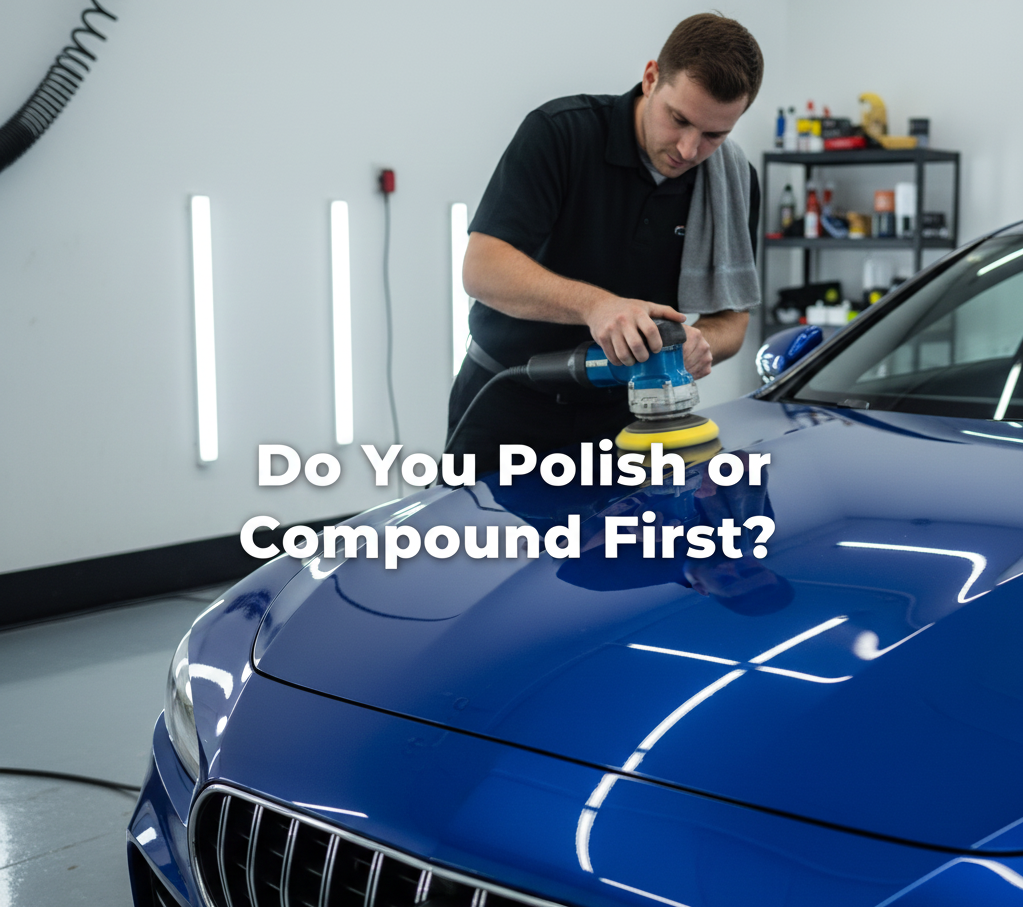
    Do You Polish or Compound First?

    Understanding whether to polish or compound first often creates confusion among car owners, especially those who want showroom-level gloss without harming their paint. At Grizzly Auto Detailing in Ashburn, VA, we help customers make smart choices that protect the vehicle’s finish while delivering the deepest shine possible. But before you decide what step to start with, you need a clear understanding of the Compound vs polish order, why it matters, and how the correct sequence shapes your final results.

    Many car enthusiasts use the terms “polishing” and “compounding” interchangeably, yet these processes differ significantly. They achieve different levels of correction, and when you apply them in the wrong order, you risk swirl marks, hazing, uneven finishes, and in some cases, paint damage. Because of this, you must understand exactly what each step does and how professional detailers structure the process for maximum clarity and gloss.

    This guide breaks down everything you need to know about whether you should polish or compound first, how the Compound vs polish order influences the outcome, and what process delivers the best results when restoring your vehicle’s shine. We will also discuss tools, time requirements, pressure control, safety considerations, and the importance of finishing steps. By the end of this article, you will understand exactly what to do, in what order, and why the sequence matters so much.


    Understanding Compounding

    Compounding acts as the heavy-cutting step. It removes significant paint imperfections such as deep scratches, heavy oxidation, water spot etching, and sanding marks. Compounds rely on abrasive particles strong enough to level the surface of your clear coat. Because they cut deeper, they correct paint faster than a polish.

    When professional technicians at Grizzly Auto Detailing compound a vehicle, they remove a thin layer of damaged clear coat to reveal a smoother, more uniform surface. This step handles defects that polishing alone cannot fix. Because compounding cuts aggressively, your paint gains clarity but may also show light haze or micro-marring afterward.

    This is where the next step becomes essential.


    Understanding Polishing

    Polishing enhances clarity, depth, and shine. Unlike compounds, polishes use finer abrasives. They correct light imperfections, refine the surface after compounding, and create the final glossy look. Polishing also prepares the surface for wax, sealant, or ceramic coating.

    When you polish, you eliminate haze, small swirls, and light marks created by the compounding pad. Therefore, polishing always produces a more reflective, smooth finish. Because of this, the Compound vs polish order always influences the result.


    So Do You Polish or Compound First?

    Here is the clear answer:

    You compound first, then polish.

    This simple sequence ensures you remove defects with the aggressive step first, then refine the paint to achieve shine. The Compound vs polish order works like sanding wood: start with a rough grit to shape it, then finish with a fine grit to smooth it.

    If you polish first, you waste time because polishing cannot remove deeper scratches. Then you must polish again after compounding, doubling your work.


    Why Compounding Always Comes Before Polishing

    Compounding Removes Deep Defects

    Deep scratches and heavy oxidation require a strong abrasive. Only a compound can correct these issues. Polishing without compounding leaves imperfections behind and gives you a less uniform finish.

    Polishing Refines the Surface

    Because compounding sometimes leaves micro-hazing, you need polishing to restore gloss. The Compound vs polish order guarantees a flawless finish.

    Compounding First Saves Time

    If you polish first, you will polish twice: once before compounding and once after. Following the correct order saves time and energy.

    You Reduce Paint Removal

    Each correction step removes a small layer of clear coat. Using the correct Compound vs polish order (compound → polish) minimizes unnecessary cutting and preserves paint longevity.


    How to Determine If You Need Compounding First

    Not every vehicle needs compounding. To decide whether your car needs the heavier step, you should inspect the paint under bright lighting, LED flashlights, or sunlight.

    You should pick compounding first when you see:

    • Deep scratches
    • Swirl marks
    • Water spot etching
    • Oxidation
    • Heavy defects
    • Sanding marks
    • Dull, chalky surfaces

    Light swirl marks or faint imperfections do not require compounding. In those cases, polishing alone works perfectly.


    How Polishing Enhances the Final Result

    Once you finish compounding, polishing brings out the deep gloss and mirror-like shine. The finer abrasives eliminate micro-marring, leave the surface smooth, and enhance reflectivity. Without polishing, your paint will look corrected but not finished.

    Polishing also improves:

    • Clarity
    • Color depth
    • Reflectiveness
    • Smoothness
    • Coating bond strength

    The vehicles we polish at Grizzly Auto Detailing always gain a richer glow after the final polish stage, which shows how essential it is to finish the process properly.


    The Importance of Choosing the Right Pad

    Your pad selection influences the cutting strength and finish quality. This makes Compound vs polish order even more important because the pad determines how aggressive the step becomes.

    Compounding Pads

    • Wool pads (fastest cut)
    • Microfiber pads
    • Heavy-cut foam pads

    Polishing Pads

    • Soft foam finishing pads
    • Medium polish pads
    • Ultrafine pads

    Using aggressive pads during polishing creates haze instead of shine, while soft pads during compounding waste time. This is why the correct sequence matters so much.


    Tools That Make the Process Easier

    The right tools produce predictable results. Professional detailers often use:

    • Dual-action polishers
    • Rotary polishers
    • Long-throw DA machines
    • LED swirl-finding lights

    These tools create consistency, reduce risk, and improve gloss. With the proper machine and pad, you follow the correct Compound vs polish order smoothly and safely.


    How Long the Process Takes

    Time varies depending on:

    • Paint hardness
    • Defect severity
    • Vehicle size
    • Pad choice
    • Machine type
    • Pressure applied

    A typical two-step correction (compound → polish) takes anywhere from 3 to 8 hours, depending on the results you want.


    Common Mistakes People Make

    Many beginners struggle because they skip steps or follow the wrong sequence. Below are the most common errors:

    Starting With Polish Instead of Compound

    This wastes time and does not correct deep defects.

    Staying Too Long in One Area

    This causes uneven paint removal.

    Using Too Much Pressure

    This creates buffer trails.

    Not Cleaning Pads

    Dirty pads reduce efficiency.

    Skipping Inspection Between Steps

    You must check your work after compounding to ensure a uniform cut before polishing.


    The Role of Protection After Polishing

    After you complete compounding and polishing, you must protect the finish. Freshly corrected paint absorbs protection products more effectively.

    You can choose:

    • Ceramic coating
    • High-gloss sealant
    • Carnauba wax

    Protection preserves your work, maintains clarity, and resists contamination.


    The Compound vs Polish Order Explained With an Analogy

    Imagine sanding a wooden surface. If you start with fine sandpaper, you waste time because deeper scratches remain. Then you need to sand everything twice. Instead, you start with coarse grit to remove defects and finish with fine grit for smoothness.

    Car paint correction works the same way. The correct Compound vs polish order always requires the heavy cut first.


    Why This Sequence Matters at Grizzly Auto Detailing

    Our shop uses a strict correction system. We diagnose paint conditions precisely and follow a refined two-stage approach:

    1. Compound to remove defects
    2. Polish to refine and enhance gloss

    This method ensures stunning results on every vehicle in Ashburn, VA. Because every car differs, we inspect the paint thoroughly before starting.


    Final Thoughts

    If you want a smooth, glossy, professionally corrected finish, you need to follow the correct process. The Compound vs polish order affects clarity, safety, paint longevity, and the final shine. When you compound first, you remove defects efficiently. When you polish afterward, you refine the paint and create a deep, high-quality glow.

    Whether you care for your daily driver or prepare your car for an event, this process guarantees professional-level results. And if you want expert help, Grizzly Auto Detailing in Ashburn, VA delivers precision, experience, and beautifully restored vehicles.


    FAQs

    1. Do I always need to compound before polishing?
    No. You only compound when defects run deeper than a polish can fix.

    2. Does compounding remove clear coat?
    Yes, compounding removes a small layer, so you must perform it carefully.

    3. Can polishing fix deep scratches?
    No. Polishing corrects only light imperfections.

    4. How do I know if my car needs compounding?
    Look for deep scratches, heavy swirls, or oxidation.

    5. How many times can I compound a vehicle?
    Only a limited number of times due to clear-coat thickness.

    6. Does polishing increase shine?
    Yes, polishing dramatically enhances gloss and clarity.

    7. Can I compound by hand?
    You can, but machine compounding works faster and more evenly.

    8. Do compounds cause haze?
    Yes, compounding may create haze that polishing removes.

    9. What pad should I use for polishing?
    Use a soft foam finishing pad for the best shine.

    10. Should I apply wax after polishing?
    Yes, wax or sealant protects the freshly corrected surface.

  • How Long Will a Paint Correction Last?

    How Long Will a Paint Correction Last?

    If you’re searching for Professional Paint Correction in Ashburn, you’ve come to the right place. At Grizzly Auto Detailing, we strive to restore your vehicle’s finish and maintain that showroom shine for as long as possible. One of the most frequent questions we receive is: how long will a paint correction last? Let’s dive into that question and give you a comprehensive answer designed for clarity, practical insight, and long‑term value.


    What Is Paint Correction?

    Before we talk about longevity, let’s recap exactly what paint correction is. Paint correction is the professional process of removing paint‑surface imperfections such as swirl marks, light scratches, oxidation, etching, and haze. It uses machine polishers, various compounds, pads, and careful technique to level the clearcoat and restore clarity and gloss. It isn’t simply masking defects—it’s physically improving the surface. As one expert writes: “Paint correction is the process of removing surface imperfections … detailers use a combination of specialized polishing compounds, pads, and machines to level the clear coat and eliminate these blemishes.” ridincleandetailing.com+1
    At Grizzly Auto Detailing in Ashburn, when we talk about Professional Paint Correction in Ashburn, we mean that full‑service approach: decontamination, compounding, polishing, finishing, inspection.


    Why Longevity Matters

    When you invest in Professional Paint Correction in Ashburn, you invest in more than just a temporary shine. You invest in:

    • Resale value — a well‑maintained and glossy car commands more attention.
    • Easy maintenance — once the paint is corrected, subsequent maintenance is simpler and safer.
    • Protection of clearcoat — while correction itself doesn’t protect, pairing it with protection prolongs results.
    • Pride of ownership — there’s nothing like driving a car that looks freshly brought home from the showroom.

    Because you’re expecting results from us at Grizzly Auto Detailing, you deserve honest answers about how long those results last—and what influences that duration.


    How Long Does Paint Correction Last?

    Here’s the key takeaway: The imperfections removed during a paint correction stay removed. But the appearance of a flawless finish depends on how you care for the vehicle afterwards, the environment it lives in, and the protection you apply after correction.

    The short answer

    • Some detailers note that a proper paint correction may last for over three years under favourable conditions. 5starautodetail.com
    • Others say in daily‑driven vehicles with average care, the pristine finish may last 6–12 months before you start seeing swirling, micro‑scratches or gloss loss. ridincleandetailing.com
    • In harsh conditions or with minimal protection, signs of wear can appear in just a few months. Love’s Auto Detail+1

    The detailed breakdown

    Here’s how different factors influence longevity:

    FactorImpact on Longevity
    Protection after correction (wax, sealant, ceramic coating)A strong protective layer helps maintain the corrected finish. Without it, new defects will show quickly. ridincleandetailing.com+1
    Usage and exposureDaily driving, exposure to sun/UV, bird droppings, road salt, off‑road use reduce lifespan of finish.
    Washing/maintenance methodsProper washing (two‑bucket method, microfiber mitts) prevents new swirl marks; poor washing shortens the effect. ridincleandetailing.com
    Quality of correction workA thorough job from a skilled professional such as we perform at Grizzly Auto Detailing yields better baseline and longer duration.
    Environment/storageGaraged vehicles, covered parking, less exposure to elements = longer lasting results.
    Clearcoat thickness and paint typeOlder vehicles or certain paint systems may have thinner clearcoats and thus less tolerance for repeated corrections. PERMAGARD

    Realistic expectations

    • For a vehicle properly corrected and protected with a premium ceramic coating + maintained well: Expect 2–4 years or more of high‑level finish.
    • For a vehicle corrected but with only wax/sealant and moderate care: Expect 1–2 years before noticeable degradation.
    • For a daily‑driver corrected but unprotected or poorly maintained: Signs of wear may appear within 6–12 months, but the underlying correction still holds value.

    What Happens After Correction? (The Corrective Steps)

    At Grizzly Auto Detailing, our process for Professional Paint Correction in Ashburn typically follows these steps. By explaining them, you’ll see why the quality of process matters to how long results last.

    Step 1: Pre‑wash / decontamination

    We begin by safely washing the vehicle with pH‑balanced shampoo, then using iron fallout removers, tar and sap removers, and a clay bar (or clay mitt) to remove embedded contaminants. This ensures the surface is clean and smooth so polishing is effective.

    Step 2: Paint inspection and test spots

    We inspect paint depth, clearcoat condition, and measure whether defects are superficial or deeper. We perform test‑spots with different pad/polish combinations to ensure we choose the right aggressiveness—this preserves clearcoat thickness and avoids over correction.

    Step 3: Compounding / cut phase

    Using an aggressive polish/compounding pad, we remove swirl marks and minor scratches. A multi‑stage correction may use a rotary or gear‑driven machine with wool or heavy foam pad for the initial cut. According to one source: “The heavy cut and medium cut stages … will typically take about 8‑12 hours to complete.” metropolitandetail.com
    We work in sections (e.g., 16″x16″) with multiple passes until level.

    Step 4: Refinement/polish phase

    We follow compounding with a finishing polish and soft foam pad to remove haze, machine polish marks, and bring out depth and gloss. This step is critical in achieving a showroom finish.

    Step 5: Surface wipe down and final inspection

    We wipe with isopropyl alcohol (IPA) or a visit‑safe surface cleaner to remove oils and polish residues, so the next protection layer bonds properly. We inspect under LED lighting to ensure no haze, swirl, or holograms remain.

    Step 6: Protect the finish

    Here we apply your chosen protective product. At Grizzly Auto Detailing we offer:

    • Premium ceramic coating (longest durability)
    • High‑quality synthetic sealant
    • Premium carnauba or polymer wax
      Choosing a ceramic coating here significantly boosts the longevity of your correction.

    Step 7: Maintenance plan & client education

    We provide you best‑practice guidelines: safe washing methods, recommended products, inspection intervals. Good maintenance ensures your results last longer.


    Why the Corrected Results Don’t Last Forever Without Maintenance

    Even though the defects are removed, the finish is still subject to new damage. Here are key reasons why you may start seeing wear again:

    1. New micro‑scratches from improper washing or automatic car washes.
    2. UV exposure & oxidation gradually degrade clearcoat and dull shine.
    3. Environmental contaminants (bird droppings, tree sap, industrial fallout) etch the surface over time.
    4. Lack of protective layer means no barrier against those elements.
    5. Repeated correction risk — each correction removes clearcoat thickness. As one expert notes, clearcoat is very thin and repeated polishing erodes it gradually. PERMAGARD

    Thus it becomes clear: the correction itself is permanent in terms of removed defects, but the glossy, flawless look depends on protection + maintenance.


    How to Get the Most Out of Your Paint Correction

    To maximise the life of your result, here’s what Grizzly Auto Detailing recommends:

    Choose high‑quality protection

    After correction, select a product that suits your usage. For long‑term durability, our ceramic coatings outperform wax or sealants. Pairing correction with this type of coating helps extend the time between corrections.

    Adopt proper washing methods

    • Use the two‑bucket method (wash & rinse bucket).
    • Use microfiber wash mitts and towels.
    • Avoid automatic brush car washes whenever possible—they introduce swirl marks.
    • Dry with a clean microfiber towel or use a blower.

    Address contaminants quickly

    Bird droppings, bug splatter, tree sap—address these fast. Letting them sit will etch the surface, requiring extra work.

    Keep up routine inspections

    Look for early signs of gloss loss or light swirling under direct sunlight. Catching issues early means a quick polishing job rather than a full correction.

    Park smart

    Whenever possible, park in shaded or covered areas. UV exposure and weather vastly impact finish longevity.

    Respect clearcoat limits

    Modern clearcoats are thin. Frequent heavy correction can risk thinning the clearcoat too much. At Grizzly Auto Detailing, we emphasise minimal necessary correction and then maintenance polish to preserve thickness.


    When Should You Consider Re‑Correction?

    Even with protection, there comes a time when a follow‑up or refresh is warranted. Here’s what to look for:

    • Loss of depth, clarity or gloss in direct sunlight.
    • Micro‑swirling across panels noticeable under LED lighting.
    • High usage or high‑exposure vehicle (daily drive, parked outdoors, high debris roads).
    • The protective layer has degraded (wax/sealant worn down).
    • You’re changing usage (e.g., vehicle going from leisure to daily driver).

    In those cases, you might schedule a refresh detailing or a light polish. But you don’t always need full correction—sometimes a “light enhancement” can extend life without full machine cutting.


    Why Choose Grizzly Auto Detailing in Ashburn?

    When you pick us for Professional Paint Correction in Ashburn, you get:

    • Expert technicians trained in state‑of‑the‑art machine polishing and protection systems.
    • A full process from decontamination to protection—a holistic approach.
    • High‑quality products used and recommended for long‑term performance.
    • Transparent communication: we inspect, test spot, and report what your vehicle actually needs.
    • Maintenance guidance tailored to your vehicle and driving conditions.
    • Local convenience in Ashburn, VA, so you have a trusted partner nearby.

    We believe that a paint correction isn’t just a service—it’s an investment in your vehicle’s value and appearance. And we want that investment to pay off for as long as possible.


    Summary

    To answer your question: how long will a paint correction last? The answer will always include a conditional element. If you drive your car every day, expose it to the elements, don’t apply protection and wash improperly, the results may begin to degrade in as little as 6–12 months. On the other hand, if you have a well‑executed correction, apply a premium ceramic coating, maintain safe washing practices, and park in good environments, you could enjoy 2–3 years or more of outstanding finish (some vehicles even longer).
    At Grizzly Auto Detailing, we deliver the highest quality approach to Professional Paint Correction in Ashburn so you can expect better longevity and better value from your vehicle.

    If you’re ready to restore your vehicle’s paint and lock in a durable finish, contact us at Grizzly Auto Detailing. Let us help you maximize your investment with a finish that lasts.


    Frequently Asked Questions (FAQs)

    1. How often should I have paint correction done?
    It depends on how well the vehicle is cared for. Some owners only need it every 2–4 years if they protect the finish properly; others might need a light enhancement or correction annually if usage and environment are harsh.

    2. Does paint correction remove the clearcoat?
    Yes, to some degree. Paint correction uses abrasives and polishing action that removes a microscopic layer of clearcoat to eliminate defects, which is why quality matters and over‑polishing is risky. PERMAGARD

    3. Is paint correction the same as waxing or detailing?
    No. Waxing covers and protects; paint correction removes defects in the clearcoat. Detailing is broad and may include wash, polish, wax, etc. Correction is a deeper restoration step.

    4. Can I get a guarantee on how long the finish will last?
    Most detailers will provide a workmanship guarantee but cannot guarantee a specific lifespan since usage, maintenance and environment impact results significantly. At Grizzly Auto Detailing, we will recommend protection and maintenance schedules to maximize results.

    5. Will I still need maintenance after paint correction?
    Absolutely. Correcting your paint does not eliminate the need for washing, washing properly, applying protective products, and keeping the vehicle clean of contaminants.

    6. What kind of protection should I apply after correction?
    We recommend a high‑quality ceramic coating for maximum longevity, or premium sealant if budget dictates. Wax is the minimum. The stronger the protection, the longer the correction finish stays looking fresh.

    7. My vehicle has only minor swirls; is full correction necessary?
    Not always. Sometimes a one‑step polish or enhancement may suffice. But if you want deep clarity and gloss, a full multi‑stage correction is preferred. We at Grizzly Auto Detailing inspect and advise what your car truly needs.

    8. How do I wash my car after correction to keep the finish?
    Use the two‑bucket method, microfiber mitts, avoid brush automatic car washes, rinse first, wash top‑down, dry with microfiber towel or air blower, avoid direct sunlight if possible.

    9. My car is parked outdoors and driven daily—how does that affect correction lifespan?
    It tends to reduce lifespan compared to garaged vehicles. Constant sun, dirt, road debris and contaminants all accelerate wear. In such cases, you may want more frequent maintenance polish or inspections.

    10. If I see some swirl marks again, does that mean the original correction failed?
    Not necessarily. The original defects were removed. New swirl marks indicate new damage. This is normal wear and tear. What matters is how quickly you catch and correct them, and how well you maintain the finish.